Key point
The ground behind the tool is that each cell type has its own probability of expressing a gene.
Based on that, SCALT leverages a collection of 471 lists of cell-type specific genes, constructed by extensive re-analysis of comprehensive and expert curated catalogues i.e. Human Protein Atlas and DISCO employing a multi-step pipeline described in the following workflow:
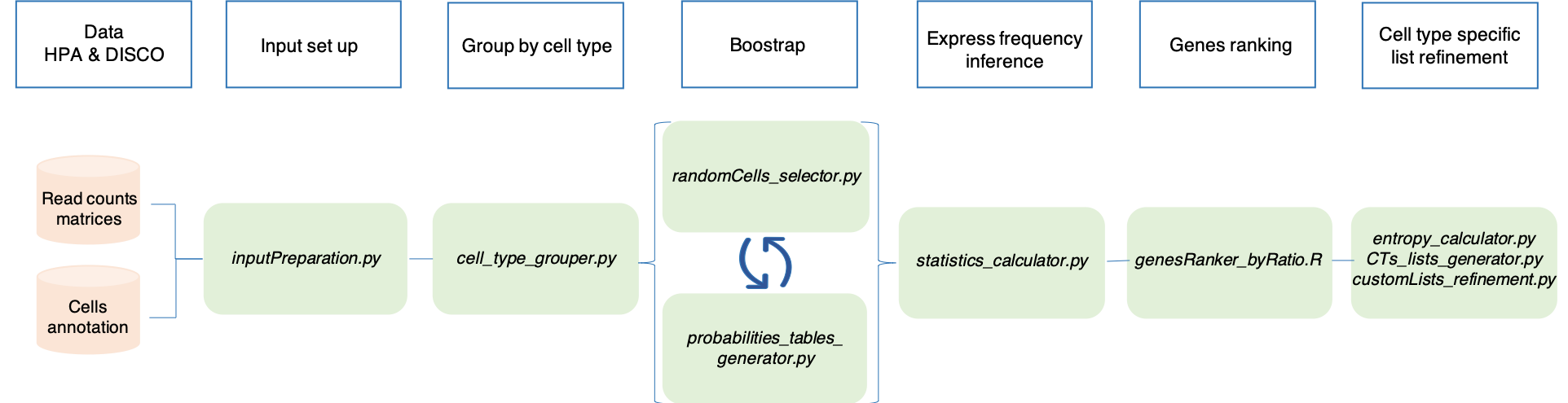
The outcome is a collection of equally-sized lists (100 genes each) containg the cell type specific genes and corresponding inferred probabilities.
Human Protein Atlas (HPA)
The Human Protein Atlas is a database that integrates multiple omics information including single cell RNA sequencing (scRNAseq) data from 31 human tissues together with peripheral blood mononuclear cells (PBMCs).
The extensive re-analysis of the database involved 689602 cells from 31 tissues classifed in 81 cell types generating a collection of 81 cell type specific lists of genes with respective probabilities and presenting the same number of genes reporting small level of overlap.
DISCO
The DISCO database is a database of Deeply Integrated Single-Cell Omics data. The current release of DISCO integrates more than 18 million cells from 4593 samples, covering 107 tissues/cell lines/organoids, 158 diseases, and 20 platforms.
4900170 cells from 24 tissues classified in 430 cell types were utilized for the creation of 430 cell type specific lists of genes with respective probabilities. Again, the lists have the same number of genes and report a small level of overlap even for closely related cell types.